

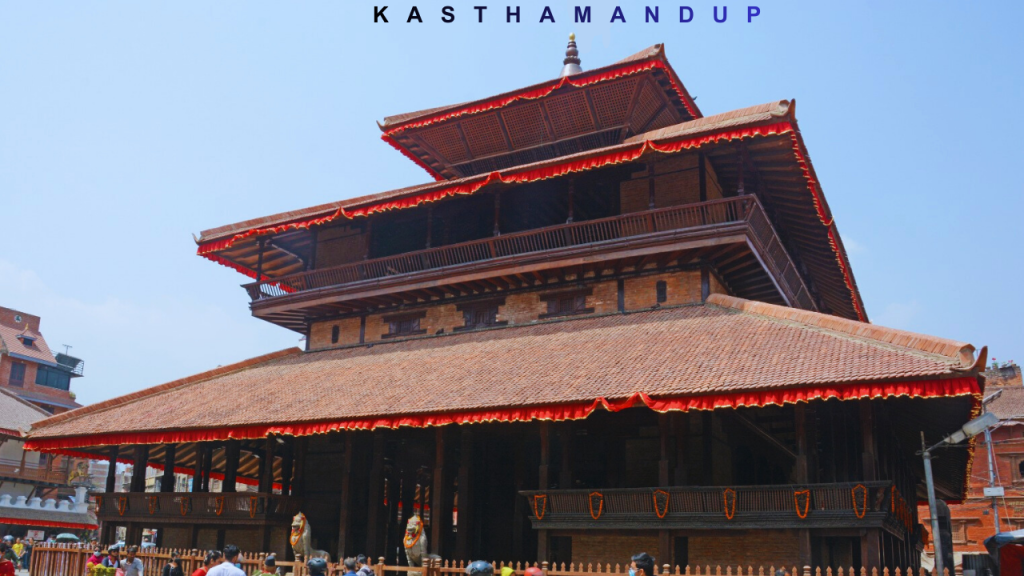
Kasthamandap
In the busy streets of Maru Tole, just south of Kathmandu Durbar Square, stands a structure that quietly holds the soul of the city itself. Kasthamandap, also known as Maru Sattal, is not just another old building. This structure gave Kathmandu its name. The city’s name comes directly from Kasthamandap.
The word comes from Kastha (wood) and Mandapa (pavilion), meaning “wooden pavilion.” Long before modern roads, traffic, or concrete buildings appeared, people from all walks of life used Kasthamandap as a shared space. Travelers rested here, merchants met, and communities gathered. Over time, this simple wooden structure grew into a powerful symbol of the city’s identity
When Was Kasthamandap Built? Understanding the Historical Debate.
Traditional chronicles (इतिहास) place the construction of Kasthamandap in 1143 CE (Nepal Sambat 263). Many historians link it to King Laxmi Narsingha Malla, although no clear inscription confirms this with complete certainty.
What makes Kasthamandap especially interesting is that historians do not fully agree on its origin.
- Some scholars suggest the structure dates to the late Licchavi period, meaning it may have existed even before the Malla era and was later repaired or rebuilt.
- Others argue that builders constructed it entirely during the Malla period, citing its architectural style and Kathmandu’s growth as an urban center in the 12th century.
- After the 2015 earthquake, scientific studies of the collapsed timber revealed that some wooden elements were older than the 12th century. This supports the idea that Kasthamandap went through multiple phases of construction and renovation.
Instead of viewing Kasthamandap as a building created at a single moment in history, we can better understand it as a living structure, shaped and reshaped over centuries.
Architectural Design: Built for People, Not Gods
Unlike most monuments in Kathmandu, Kasthamandap was not built as a temple for idol worship. It is a mandapa, a public pavilion designed for community use.
Plan and Structural System
- The building has a square plan, measuring approximately 18.73 × 18.73 meters, showing careful symmetry.
- At the center stand four massive wooden pillars, each about 6 meters tall. These form the main load-bearing core.
- Around them are 32 paired columns, set into brick bases, supporting the upper floors.
- Along the outer edge are 28 smaller columns, which hold up the wide roof of the ground floor.
This smart use of columns allows the interior to remain open and spacious while still being strong. It reflects the advanced knowledge of traditional Newar timber engineering.
Deity and Sacred Presence Inside Kasthamandap
Although Kasthamandap was primarily built as a public rest house rather than a traditional temple, it still houses a sacred deity, adding a spiritual layer to its civic role.
At the heart of Kasthamandap is a statue of Gorakhnath, a revered yogi and saint associated with the Nath tradition. Nepalese society deeply respects Gorakhnath and regards him as the spiritual guardian of the Kathmandu Valley. Alongside Gorakhnath, the site also traditionally features images of Machhindranath (Matsyendranath), linking Kasthamandap to powerful tantric and yogic traditions.
The presence of Gorakhnath explains an important aspect of Kasthamandap’s history. While the structure functioned as a communal shelter, it was never an ordinary resting place. The deity gave the space a protective and sacred character, which is why travelers, traders, and locals considered it a safe and auspicious place to rest.
Unlike formal temples:
- The deity is displayed without an enclosed sanctum.
- Rituals here are simple and informal.
- The space remains open and accessible to the public.
This unique combination of public utility and spiritual presence reflects a deeply Newar concept of urban life, where the sacred and the everyday coexist without strict separation.
Vertical Layout: How the Building Rises
Ground Floor
The ground level is an open, pillared hall. Historically, this space was used as a rest house (sattal) for travelers and locals. Its open design clearly shows its public and civic purpose.
Middle Floor
Reached by a long staircase from the western side, the middle floor repeats the same layout but on a smaller scale. This gradual reduction creates a balanced and graceful upward form.
Upper Floor
A ladder provides access to the topmost level, which uses lighter materials to reduce weight and improve stability. People likely reserved this level for restricted or symbolic activities rather than everyday public use.
Roof Design and Finial
All three levels share the same roof angle, which creates a strong visual harmony. The roofs extend outward, forming wraparound balconies that protect the structure from rain and harsh sunlight, a practical design for Kathmandu’s monsoon climate.
At the very top sits a cone-shaped gajur (finial). While Kasthamandap is mainly a secular structure, the gajur symbolically connects it to sacred architecture, blending civic and spiritual traditions.
Materials and Construction Techniques
Kasthamandap is famous for its extraordinary use of wood. Local tradition says builders constructed it using timber from a single tree.. While this is likely symbolic rather than literal, it highlights the massive scale of wood used.
Key construction features include:
- Instead of iron nails, builders relied on wooden pegs and interlocking techniques for all joints.
- Builders mainly used brick masonry for the base and column foundations.
- Craftsmanship follows Newar building traditions, passed down through generations.
This approach made the structure flexible and resilient, especially important in an earthquake-prone region.
Social and Cultural Importance
For centuries, Kasthamandap served as:
- A resting place for travelers and traders
- A meeting space for the public
- A shelter during festivals and processions
Unlike temples that focus on deity worship, Kasthamandap represented community life. It was open to everyone, regardless of status or background.
Its greatest symbolic importance lies in one simple fact:
Kathmandu is named after Kasthamandap.
This alone places the structure at the very center of Nepal’s urban and cultural history.
Conclusion: More Than a Monument
Kasthamandap is not just an architectural landmark, it is a story written in wood, shaped by time, memory, and people whether viewed through Licchavi roots, Malla-era development, or Newar craftsmanship, it stands as a powerful symbol of continuity and resilience.
Rather than remaining a frozen relic of the past, Kasthamandap reminds us that cities are built not only from materials, but from shared spaces, collective care, and living traditions.
Do, visit and give us you opinion in it.
Kasthamandap overview:
What is the meaning of Kasthamandap?
The word comes from Kastha (wood) and Mandapa (pavilion), meaning “wooden pavilion.” The fun fact is “Kathmandu got its name from Kasthamandap.”
Who built Kasthamandap ?
Some scholars suggest the structure dates to the late Licchavi period, meaning it may have existed even before the Malla era and was later repaired or rebuilt, many links with Narsingha Malla, although no clear inscription confirms this with complete certainty but was latter re-constructed and re-innovate after the devasting earthquake in 2015
When was Kasthamandap built?
Traditional chronicles (इतिहास) place the construction of Kasthamandap in 1143 CE (Nepal Sambat 263).
Where is Kasthamandap Temple located?
It is located just at south of Kathmandu Durbar Square, know as “Maru tole”.
For more interesting blogs and artiles click here: https://insightpress.xyz/blog/


hello