What is SEO Content Writing?
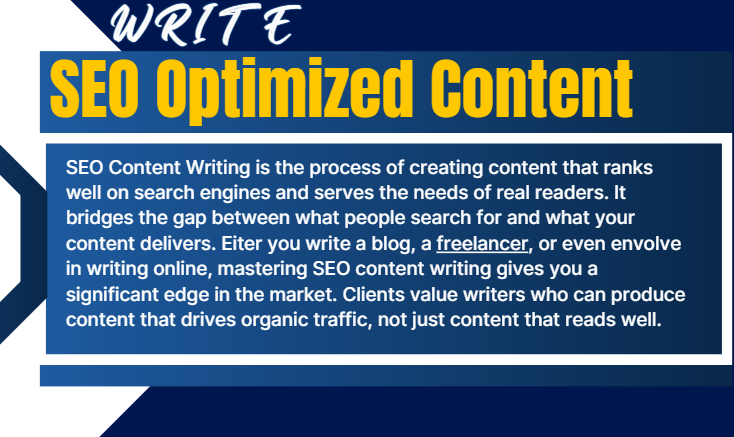
SEO content writing is the process of creating content that ranks well on search engines and serves the needs of real readers. It bridges the gap between what people search for and what your content delivers. Eiter you write a blog, a freelancer, or even envolve in writing online, mastering SEO content writing gives you a significant edge in the market. Clients value writers who can produce content that drives organic traffic, not just content that reads well.
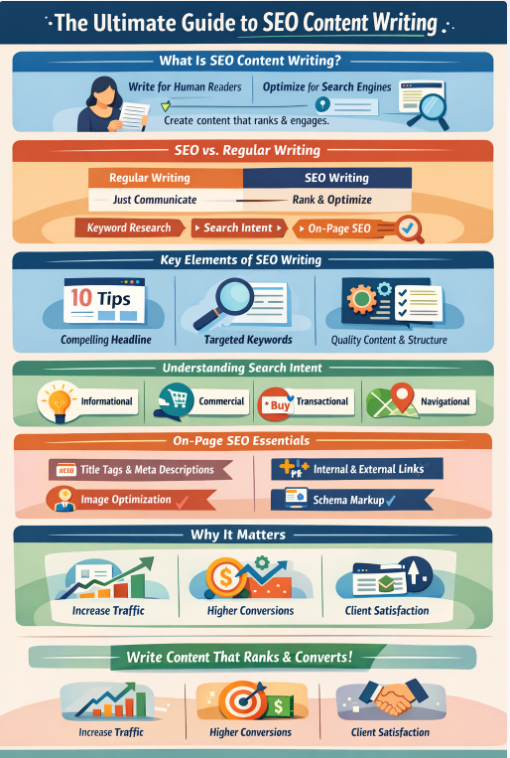
Think of SEO writing as a two-audience challenge. You write for human readers who need clarity, value, and engagement. At the same time, you write for search engine crawlers that analyze structure, keywords, and relevance. The best SEO writers do both naturally.
“Great SEO writing starts with understanding your audience and their intent, then structures high-quality, readable content around strategic keywords while optimizing technical elements like titles, meta descriptions, and links.“
SEO Writing vs. Regular Writing — What’s the Difference?
Regular writing focuses purely on communication. SEO writing adds a strategic layer on top of that. Both require clear language, strong structure, and a compelling argument. However, SEO writing also demands keyword research, intentional formatting, and a deep understanding of search intent. Furthermore, SEO writing treats every headline, paragraph, and meta tag as an opportunity to signal relevance to search engines.
| Factor | Reular Writing | SEO Writing |
|---|---|---|
| Primary Goal | Communicate an idea | Rank + communicate |
| Keyword Use | Organic, no strategy | Strategic & intentional |
| Structure | Writer’s preference | Hierarchy-driven (H1-H4) |
| Audience | Human readers only | Humans + search engines |
| Performance Metric | Engagement & reads | Rankings, traffic, conversions |
Why SEO Content Writing Matters for Your Business
For writers, SEO skills directly translate into higher rates and more consistent work. Clients increasingly demand content that performs, not just content that looks good. Moreover, as AI-generated content floods the web, human writers who understand SEO strategy, search intent, and audience psychology become even more valuable. Therefore, investing in your SEO writing skills is one of the highest-ROI moves you can make as a freelance professional.
Understanding the Foundations of SEO
Before you write a single word, you need to understand how search engines works and how it decides what content deserves to rank, this foundational knowledge shapes every SEO decision you make as a writer.
How Search Engines Work (Crawling, Indexing, Ranking)
Search engines follow a three-step process to deliver results. First, they crawl the web using automated bots called spiders. These bots follow links across millions of pages to discover content. Next, they index what they find, storing page data in a massive database. Finally, they rank pages based on hundreds of factors when a user enters a query.
As a writer, your job is to create content that gets crawled efficiently, indexed accurately, and ranked highly. You achieve this through clean structure, relevant keywords, quality content, and strong internal linking.
What Is E-E-A-T and Why It Matters
E-E-A-T stands for Experience, Expertise, Authoritativeness, and Trustworthiness. Google uses these signals to evaluate content quality, especially for topics that affect people’s health, finances, or safety. As a freelance writer, demonstrating E-E-A-T means citing credible sources, presenting accurate information, and writing from a place of genuine knowledge or research.
Pro Tip: Add author bios to every article you write. A short bio that highlights your credentials and experience directly boosts E-E-A-T signals for your client’s site.
The Role of AI in Modern Search (AI Overviews, SGE)
Search Generative Experience (SGE) and AI Overviews are reshaping how users interact with search results. Google now generates AI-powered summaries at the top of many search results pages. This shift does not make SEO writing obsolete. In fact, it raises the stakes. AI Overviews pull from authoritative, well-structured content. Therefore, writers who format content with clear definitions, concise answers, and logical structure are most likely to appear in these AI-generated responses.
Keyword Research — The Starting Point
Keyword research is the backbone of every successful SEO content piece. It tells you what your audience is searching for, how competitive those topics are, and what language to use throughout your content. Without solid keyword research, even the best-written article can fail to rank.
How to Find Your Primary Keyword
Your primary keyword is the main term your content targets. It should reflect the core topic of your article and match the search intent of your target audience. Finding it requires using the right tools and applying judgment about volume, difficulty, and relevance.
Using Keyword Research Tools (Google Keyword Planner, Ubersuggest, Semrush, Ahrefs)
Each keyword tool offers unique strengths. Google Keyword Planner gives you search volume data directly from Google. Ubersuggest provides competitive difficulty scores and content ideas at a lower price point. Semrush and Ahrefs are the industry’s most powerful tools, offering competitor analysis, keyword gap reports, and detailed SERP overviews. As a freelance writer, even free access to one of these tools puts you ahead of most content creators.
Evaluating Keyword Difficulty, Volume & Relevance
A high-volume keyword is not always the right target. You need to balance three factors:
- Search Volume: How many people search for this term each month?
- Keyword Difficulty (KD): How hard is it to rank for this keyword against existing content?
- Relevance: Does this keyword actually match what your content is about?
For new or low-authority websites, target keywords with a KD score below 40. This gives you a realistic path to page one rankings without competing against domain authorities in the 80-90+ range.
How to Build a Keyword List
A single primary keyword is never enough. You need a cluster of related terms to build topical authority and cover the full scope of your subject. Start with your primary keyword, then expand outward.
Long-Tail Keywords & Why They Convert Better
Long-tail keywords are longer, more specific phrases that typically have lower search volume but higher purchase or conversion intent. For example, ‘SEO content writing tips for beginners’ is a long-tail version of ‘SEO writing.’ It attracts readers who know exactly what they want, which means they convert at a higher rate. Furthermore, long-tail keywords are less competitive, making them ideal targets for newer sites or niche content strategies.
LSI (Latent Semantic Indexing) & Related Terms
LSI keywords are terms and phrases that are semantically related to your primary keyword. Search engines use them to understand the full context of your content. For instance, an article about ‘SEO content writing’ might naturally include terms like ‘meta descriptions,’ ‘search intent,’ ‘keyword density,’ and ‘organic traffic.’ Using these related terms throughout your content signals topical depth to search engines without forced keyword repetition.
Understanding Search Intent Behind Keywords
Search intent is the most critical factor in keyword strategy. It describes the reason behind a user’s search. Matching your content to search intent is non-negotiable. A mismatch between your content and search intent will hurt your rankings regardless of how well-written the article is.
Informational Intent
Users searching with informational intent want to learn something. Queries like ‘how to write SEO content’ or ‘what is keyword density’ signal this intent. The best format for informational queries includes step-by-step guides, tutorials, and comprehensive explainers.
Commercial Intent
Commercial intent appears when users are comparing options before making a purchase decision. Queries like ‘best SEO tools for writers’ or ‘Semrush vs Ahrefs’ reflect this intent. These pages perform best with comparison tables, pros and cons lists, and detailed product breakdowns.
Transactional Intent
Transactional queries signal that a user is ready to take action. Terms like ‘hire SEO content writer’ or ‘buy Semrush subscription’ fall into this category. Content targeting transactional intent should include clear CTAs, pricing information, and trust signals.
Navigational Intent
Navigational searches target a specific website or brand. Users searching ‘Ahrefs login’ or ‘Semrush keyword tool’ already know where they want to go. These queries are typically dominated by branded pages and are less relevant to most content strategies.
Researching & Planning Your Content
The best SEO writers invest significant time in research and planning before they write. Solid planning prevents wasted effort and dramatically improves the quality of your final content.
Analyze What’s Already Ranking on Page 1
Before you write, study the top 5 to 10 results for your target keyword. Ask yourself: What topics do they cover? How long are the articles? What format do they use? This analysis reveals what Google already considers high-quality content for this query. Your goal is not to copy these results but to understand the baseline and then do better.
Identify Content Gaps & Your Unique Angle
Content gaps are topics or questions that existing top-ranking pages fail to cover adequately. Identifying these gaps gives you a unique angle and a genuine reason for your content to exist. Look for unanswered questions in comment sections, Reddit threads, and forums related to your topic. Then, build your content around filling those gaps.
Define Your Target Audience & Their Pain Points
Knowing your audience shapes every word you write. For freelance writers working on client projects, define the audience before you outline. Who are they? What do they already know? What problem are they trying to solve? The more specific your audience definition, the more targeted and effective your content becomes.
Create a Content Outline Before Writing
A strong outline is your roadmap. It prevents writer’s block, ensures logical flow, and helps you cover all necessary subtopics. Structure your outline using your primary keyword, secondary keywords, and LSI terms distributed across your H2 and H3 headings. Additionally, noting the word count target and key points for each section keeps your writing focused and efficient.
Writing SEO Optimized Content (Step by Step)
Now that your research and planning are complete, it is time to write. Follow these seven steps to produce content that ranks, engages, and converts.
Step 1 — Craft a Compelling, Keyword-Rich Headline
Your headline is the first thing both users and search engines see. It determines whether someone clicks through from a search result page. A strong headline includes your primary keyword, communicates clear value, and creates curiosity or urgency.
Power Words & Emotional Triggers in Headlines
Power words trigger an emotional response that drives clicks. Words like ‘proven,’ ‘ultimate,’ ‘essential,’ ‘effortless,’ and ‘complete’ signal high value. Emotional triggers like ‘stop making,’ ‘never struggle again,’ and ‘transform your’ speak directly to the reader’s desire for change or improvement.
Number-Based Headlines & Why They Work
Numbered headlines outperform other formats consistently. They set clear expectations, promise digestible content, and stand out visually in search results. Headlines like ‘7 Proven Ways to Write SEO Content That Ranks’ or ’10 SEO Writing Mistakes That Are Killing Your Rankings’ are specific, scannable, and compelling.
Ideal Headline Length (Under 60 Characters)
Keep your headline under 60 characters to ensure it displays fully in search engine results pages (SERPs). Longer headlines get truncated, which reduces click-through rates. Use a free SERP snippet preview tool to check your headline length before publishing.
Step 2 — Write a Hook Introduction That Grabs Attention
Your introduction determines whether readers stay or bounce. Search engines measure dwell time, so a compelling opening that keeps readers engaged directly impacts your rankings. Get to the point quickly, acknowledge the reader’s problem, and promise a clear solution.
The Problem-Agitate-Solution (PAS) Formula
The PAS formula is one of the most effective introduction frameworks in SEO writing. Start by naming the problem the reader faces. Then agitate it by highlighting the consequences of not solving it. Finally, introduce your content as the solution. This three-step structure immediately demonstrates relevance and builds reading momentum.
Using Statistics, Questions & Stories to Open
Statistics establish credibility from the first sentence. Questions engage the reader’s curiosity and signal that you understand their situation. Short, relatable stories create an emotional connection that keeps readers invested. Each of these techniques serves a different audience type, so choose based on your content’s tone and purpose.
Step 3 — Structure Your Body Content with Clear Headers
Clear, hierarchical headings are essential for both user experience and SEO. They help readers scan your content and find the sections most relevant to them. They also signal content structure to search engine crawlers, making it easier to understand and index your article.
Using Hierarchical Headings (H2 → H3 → H4)
Use H2 headings for major sections, H3 headings for subsections within those sections, and H4 headings for deeper breakdowns within subsections. Never skip heading levels. This logical hierarchy creates a clear content architecture that benefits both readers and search engines.
One Idea Per Section — Keep It Focused
Each section under a heading should address one specific idea or question. When you cover multiple ideas in a single section, readers lose the thread and search engines find it harder to determine relevance. Short, focused sections are easier to read, easier to rank, and more likely to be featured as snippets.
Step 4 — Integrate Keywords Naturally
Keyword integration is a skill that separates amateur SEO writers from professionals. Your goal is to include your target keywords in a way that feels natural and adds value to the reader. Forced keyword insertion damages readability and signals spam to search engines.
Where to Place Keywords (First 100 Words, Headers, Body, Conclusion)
Place your primary keyword in these key locations:
- Within the first 100 words of your introduction
- In at least one H2 heading
- Naturally throughout the body, approximately every 300 to 500 words
- In the conclusion paragraph
- In your meta title and meta description
Secondary keywords and LSI terms should appear naturally throughout, especially in H3 and H4 headings where appropriate.
Keyword Density — How Much Is Too Much?
Keyword density refers to how often your target keyword appears relative to total word count. There is no perfect percentage, but most SEO professionals recommend keeping it between 1% and 2%. For a 1,500-word article, that means using your primary keyword 15 to 30 times. However, context and readability always trump density targets.
Avoiding Keyword Stuffing
Keyword stuffing is the practice of forcing keywords into content at an unnatural frequency. It reads poorly, damages user experience, and can trigger Google penalties. Instead of repeating the same exact keyword, use synonyms and related terms to maintain topical relevance while keeping your content readable.
Step 5 — Write for Humans First, Search Engines Second
The most important principle in modern SEO writing is to prioritize the reader. Search engines have become sophisticated enough to recognize and reward content that genuinely serves people or not, writing which are clear, engaging, and useful will always outperform content that optimizes for algorithms at the expense of readability.
Use Simple, Conversational Language
Write like you are explaining something to a knowledgeable colleague, not writing an academic paper. Use contractions where natural. Choose common words over complex alternatives. Conversational writing keeps readers engaged and reduces bounce rate, which positively impacts your rankings over time.
Aim for an 8th-Grade Readability Level
Research consistently shows that content written at an 8th-grade reading level performs best across most online audiences. This does not mean dumbing down your content. It means presenting complex ideas in accessible language. Tools like the Hemingway Editor calculate your readability score and identify sentences that are too complex.
Short Paragraphs, Bullet Points & White Space
Online readers scan before they read. Walls of text cause immediate bounces. Keep paragraphs to three or four sentences maximum. Use bullet points and numbered lists to present information that benefits from a visual structure. White space between sections gives the eye a natural resting point and makes content feel approachable rather than overwhelming.
Step 6 — Add Depth & Value to Your Content
Thin, shallow content rarely ranks well anymore. Google’s Helpful Content updates have pushed low-value, surface-level articles down the rankings. Depth and genuine value are now competitive requirements, not optional extras.
Ideal Content Length (1,000+ Words for Competitive Topics)
Content length should match the complexity of the topic and the expectations set by competing pages. For competitive keywords, aim for 1,500 to 2,500 words. For in-depth guides and pillar content, 3,000 or more words is appropriate. However, never pad content to hit a word count. Every paragraph should earn its place by adding value.
Support Claims with Data, Stats & Case Studies
Data-backed claims are more persuasive and more credible than unsupported assertions. When you cite industry studies, research reports, or specific statistics, you demonstrate E-E-A-T and give readers a reason to trust your content. Always link to original sources, not secondary aggregators, to maintain credibility.
Include Expert Quotes & Original Insights
Expert quotes add authority and variety to your content. They show that real professionals validate your points. Original insights, on the other hand, are your unique contribution to the conversation. These might include personal experience, counter-intuitive analysis, or synthesized perspectives that readers cannot find anywhere else. Original thinking is what makes your content link-worthy.
Step 7 — Write a Strong Conclusion with a Clear CTA
Your conclusion is your final opportunity to reinforce your message and direct reader behavior. A weak conclusion leaves readers unsure what to do next. A strong one creates momentum and drives action.
Summarize Key Takeaways
Briefly recap the most important points from your article. Keep it concise. Two to four sentences is usually enough to remind the reader of the value they received without repeating the entire article.
Guide the Reader to the Next Step
Every piece of content should guide the reader toward a next action. This might be downloading a resource, reading a related article, signing up for a newsletter, or contacting a business. Your call to action should feel like a natural extension of the content, not a sales pitch dropped in at the end.
On-Page SEO Optimization
On-page SEO refers to all the technical and content elements you control directly on the page. Getting these right amplifies the impact of your writing and ensures search engines can fully understand and index your content.
Writing an Effective Title Tag
Your title tag is the blue linked text that appears in search results. It is one of the most important on-page SEO elements. It must be compelling enough to earn a click and optimized enough to signal relevance to search engines.
Ideal Length (~55–60 Characters)
Title tags longer than 60 characters get cut off in SERPs. Keep your titles between 50 and 60 characters to ensure full visibility. Use a character counter or SERP preview tool to check before publishing.
Placing Your Primary Keyword First
Front-load your primary keyword in the title tag whenever possible. Search engines give more weight to words that appear earlier in the title. Structuring your title as ‘Primary Keyword: Supporting Benefit or Detail’ is a reliable format that works across most content types.
Crafting a Click-Worthy Meta Description
The meta description appears below your title tag in search results. While it does not directly influence rankings, it significantly impacts click-through rate (CTR). A strong meta description acts as a mini advertisement for your page.
Ideal Length (~150–160 Characters)
Keep your meta description between 150 and 160 characters. Longer descriptions get truncated. Use every character wisely. Include your primary keyword naturally, lead with a benefit, and end with a subtle call to action.
Including a Value Proposition & Keyword
Your meta description should answer the question: ‘Why should I click this result?’ Lead with the benefit the reader will gain. Include your primary keyword to trigger the bold formatting that appears when it matches a search query. This visual distinction increases CTR significantly.
Creating a Clean, Descriptive URL Slug
Your URL slug is the part of the web address that identifies a specific page. Keep it short, descriptive, and keyword-rich. Use hyphens between words, not underscores. Avoid dates, numbers, and stop words like ‘a,’ ‘the,’ and ‘for.’ A clean URL like /seo-content-writing-guide performs better than /2026/03/how-to-write-seo-content-for-beginners-complete.
Adding Alt Text to Every Image
Alt text is a written description of an image that serves two purposes. First, it allows visually impaired users to understand images through screen readers. Second, it gives search engines context about the image content. Write descriptive alt text that includes your target keyword where it fits naturally. Never stuff keywords into alt text — keep it accurate and human-readable.
Using Schema Markup & Structured Data
Schema markup is a type of code you add to your page to help search engines understand your content more precisely. It enables rich results like star ratings, FAQ drop-downs, and article timestamps in SERPs. As a writer, you may not implement schema yourself, but understanding it helps you format content in ways that are schema-friendly, particularly for FAQs, how-to guides, and review articles.
Linking Strategy
Links are one of the most powerful ranking signals in SEO. A smart linking strategy helps search engines discover and understand your content while building authority across your site and across the web.
Internal Linking — Distribute Authority Across Your Site
Internal links connect one page on your site to another. They pass authority (often called ‘link juice’) between pages and help search engines understand the relationship between your content. A strong internal linking strategy supports your most important pages and helps newer content get discovered faster.
How to Choose Anchor Text
Anchor text is the clickable text of a link. Use descriptive anchor text that tells both the reader and search engines what the linked page is about. For example, ‘learn more about keyword research techniques’ is more effective than ‘click here.’ Vary your anchor text naturally rather than using exact-match keywords every time.
How Many Internal Links Per Post?
There is no fixed rule, but most SEO professionals recommend two to five internal links per 1,000 words. Each link should serve a genuine purpose for the reader. Avoid linking for the sake of meeting a quota. Relevance and context always matter more than quantity.
External Linking — Cite Authoritative Sources
External links to credible, authoritative sources strengthen the trustworthiness of your content. They show readers and search engines that you base your claims on solid evidence. Link to primary research, government data, recognized industry publications, and established experts in your field.
Why Linking to Trusted Sites Boosts Your Credibility
When you link to authoritative sources, you borrow a degree of their credibility. Search engines recognize when content exists within a web of high-quality resources. Furthermore, outbound links to respected sites signal that your content is well-researched and trustworthy, which aligns with E-E-A-T principles.
Building Backlinks (Off-Page SEO)
Backlinks are links from other websites that point to your content. They are one of the strongest ranking signals in SEO. Earning quality backlinks requires creating content that others genuinely want to reference.
Guest Posting & Outreach
Guest posting on authoritative websites in your niche is one of the most reliable backlink strategies. It places your content in front of established audiences while earning a valuable link back to your site. Effective outreach requires a personalized pitch that leads with value for the host publication’s audience, not just a link request.
Creating Link-Worthy Content (Data, Infographics, Research)
The most powerful backlink strategy is creating content that others naturally want to cite. Original research, proprietary data, comprehensive guides, and unique data visualizations are all highly link-worthy formats. When your content provides information that is not available elsewhere, other writers and journalists will reference and link to it organically.
Visual & Multimedia Optimization
Visual content enhances the reader’s experience, increases time on page, and provides additional ranking opportunities through image and video search. Integrating multimedia thoughtfully is a mark of professional-level SEO writing.
Why Images, Infographics & Videos Improve SEO
Visual content improves multiple SEO metrics simultaneously. Images break up text and make content more scannable, reducing bounce rate. Infographics distill complex information into shareable, linkable assets. Videos increase dwell time and engagement. Each of these behavioral signals — lower bounce rate, higher dwell time, more shares — sends positive ranking signals to search engines.
Image Optimization (Compression, File Names, Alt Text)
An unoptimized image can dramatically slow down your page load time, which directly impacts rankings. Always compress images before uploading to reduce file size without sacrificing quality. Use descriptive, keyword-rich file names rather than generic names like ‘image001.jpg.’ And always write accurate, descriptive alt text for every image on the page.
Embedding Videos & Adding Transcriptions
Embedding relevant videos increases the average time users spend on your page. Transcriptions of video content add indexable text to your page, creating additional keyword opportunities and making your content accessible to users who cannot watch video. Furthermore, transcriptions allow search engines to fully understand and index your video content.
Using Custom Graphics & Data Visualizations
Custom graphics and data visualizations serve a dual purpose. They make complex information immediately understandable for readers, and they create unique, visually distinctive assets that other sites want to embed and link to. Original visual content is one of the highest-leverage investments you can make in a content piece, particularly for linkable data-driven articles.
Technical Factors That Affect Your Content’s Performance
Even the best-written content can underperform if the underlying technical infrastructure is weak. As a freelance writer, you may not control these factors directly, but understanding them helps you advise clients and make better decisions when you do have control.
Site Speed & Page Load Time
Page load time is a confirmed Google ranking factor. Slow pages frustrate users and increase bounce rates, both of which hurt rankings. Core issues that slow pages include uncompressed images, too many third-party scripts, and poor server response times. Google’s PageSpeed Insights tool identifies specific issues and provides actionable recommendations.
Mobile-First Optimization
Google uses mobile-first indexing, meaning it primarily evaluates the mobile version of your content for ranking purposes. Therefore, every piece of content you create must display and perform correctly on mobile devices. This means short paragraphs, tap-friendly navigation, fast load times, and legible font sizes without zooming.
Core Web Vitals (LCP, FID, CLS)
Core Web Vitals are a set of specific metrics Google uses to evaluate user experience. Largest Contentful Paint (LCP) measures loading performance. First Input Delay (FID) measures interactivity. Cumulative Layout Shift (CLS) measures visual stability. Pages that score well on these metrics receive a ranking boost. Understanding these signals helps you optimize images, minimize JavaScript, and structure content for stable rendering.
Secure Website (HTTPS)
HTTPS is a baseline technical requirement for ranking in modern search. Google confirmed HTTPS as a ranking signal years ago. Beyond SEO, HTTPS protects user data and builds trust. If a client’s website still runs on HTTP, flag it as an urgent technical fix.
Optimizing for Featured Snippets & AI Overviews
Featured snippets appear above organic results in a box at the top of the SERP. Winning a featured snippet for a competitive keyword can dramatically increase your click-through rate. With the rise of AI Overviews, formatting for these zero-click placements has become even more important.
What Are Featured Snippets & How to Win Them
Featured snippets pull a concise answer from a web page and display it directly in search results. They appear in paragraph, list, and table formats. To win a featured snippet, identify questions your target audience is asking and answer them directly and concisely within your content. Place the answer immediately below a relevant H2 or H3 heading.
Formatting Content for AI-Generated Answers
AI Overviews draw from content that provides clear, factual, well-structured answers. To increase your chances of being cited in AI-generated results, write concise definitions at the start of relevant sections, use numbered lists for processes, and provide direct answers to common questions before elaborating. Structured, predictable formatting is what makes your content machine-readable.
Using Tables, Lists & Concise Definitions Strategically
Tables work best for comparisons and data. Numbered lists work best for sequential processes and step-by-step instructions. Bullet lists work best for collections of items without a hierarchy. Concise paragraph definitions — two to three sentences that answer a question directly — are ideal for featured snippet paragraph pulls. Knowing which format to use for which type of information is a high-value SEO writing skill.
SEO Content Writing Tools You Need
The right tools make your SEO writing process faster, more data-driven, and more effective. You do not need every tool on this list. However, having at least one strong option in each category gives you a significant competitive advantage.
Keyword Research Tools (Ubersuggest, Semrush, Ahrefs)
Ubersuggest is an accessible entry point for freelancers on a budget. It provides keyword suggestions, difficulty scores, and competitor analysis. Semrush and Ahrefs are the gold standard for professional SEO. Both offer comprehensive keyword research, competitor gap analysis, backlink data, and content optimization features. If you write SEO content professionally, investing in one of these tools pays for itself quickly.
Content Optimization Tools (Surfer SEO, Clearscope, Yoast)
Content optimization tools analyze top-ranking pages for your target keyword and provide real-time guidance as you write. Surfer SEO scores your content against competitors and suggests the optimal use of keywords, headings, and word count. Clearscope provides a grade-based content score with keyword recommendations. Yoast is a WordPress plugin that evaluates on-page SEO elements and readability. These tools remove much of the guesswork from SEO optimization.
Readability Tools (Hemingway Editor, Grammarly)
The Hemingway Editor highlights sentences that are too long, passive voice usage, and readability issues. It grades your content by reading level, making it easy to hit that 8th-grade target. Grammarly goes further, catching grammatical errors, unclear phrasing, and tone inconsistencies. Both tools are essential for producing clean, professional copy that reads well on any device.
Analytics & Tracking Tools (Google Search Console, Google Analytics)
Google Search Console shows you how your content performs in search results. It reveals which queries bring users to your page, your average position, and your click-through rate. Google Analytics tracks user behavior on your site, including bounce rate, session duration, and conversion pathways. Together, these free tools provide everything you need to measure SEO performance and identify improvement opportunities.
AI Writing Assistants — When & How to Use Them
AI writing assistants can accelerate your research, help you overcome writer’s block, and generate structural ideas. However, they are tools to support your writing, not replace it. AI-generated content frequently lacks the original insights, nuanced judgment, and genuine E-E-A-T signals that search engines and readers increasingly demand. Use AI to draft outlines, generate topic ideas, and speed up research. Then apply your expertise, voice, and judgment to produce content that stands apart.
Publishing, Promoting & Tracking Your Content
Publishing a great article is only the beginning. Content promotion and performance tracking are what turn a good piece into a long-term traffic asset.
Pre-Publish Checklist (Final Proofing & QA)
Before you publish, run through this checklist:
- Primary keyword appears in the title, first 100 words, at least one H2, and the conclusion
- Meta title is under 60 characters and includes the primary keyword
- Meta description is 150 to 160 characters with a clear value proposition
- URL slug is short, descriptive, and keyword-rich
- All images have descriptive alt text
- Internal links point to relevant, high-value pages
- External links point to authoritative sources
- Content has been proofed for grammar, spelling, and readability
- Mobile display has been tested and confirmed
Content Promotion Strategies
Publishing without promotion is one of the most common mistakes content creators make. Even excellent content needs an initial push to gain traction.
Social Media Distribution
Share your content across all relevant social channels immediately after publishing. Tailor the messaging for each platform. LinkedIn responds well to professional insights and data. Twitter favors short, punchy takes with a link. Facebook and Instagram work best with visual elements from the content. Engage with comments and questions to build early social signals.
Email Marketing & Newsletters
An email list is the most reliable distribution channel you own. Send new content to your subscribers within 24 to 48 hours of publishing. Segment your list where possible to deliver content that is highly relevant to specific audience groups. Email-driven traffic signals to search engines that real people find your content valuable.
Content Repurposing (Blog → Video → Infographic)
A single well-researched article contains enough material for multiple content formats. Transform your blog post into a YouTube video script, a LinkedIn carousel, an infographic, or a podcast episode. Each format reaches a different segment of your audience and creates additional opportunities for backlinks and shares. Repurposing maximizes the ROI of your initial research investment.
Tracking Performance & KPIs
You cannot improve what you do not measure. Set clear KPIs for every piece of content before publishing.
Organic Traffic & Rankings
Track keyword rankings weekly during the first 90 days after publication using Google Search Console or your SEO tool of choice. Monitor organic traffic to the page through Google Analytics. Understand that new content typically takes three to six months to reach its peak ranking potential.
Bounce Rate & Dwell Time
Bounce rate measures the percentage of users who leave after viewing only one page. High bounce rates signal that users did not find what they expected. Dwell time measures how long users stay on your page. Low dwell time indicates that users did not find your content engaging or valuable. Both metrics influence rankings and both improve with better content quality and stronger introductions.
Conversions & Engagement Metrics
Ultimately, the value of content is measured by what it drives. Track conversions like email sign-ups, contact form submissions, and product purchases that originate from organic traffic. Also track engagement signals like comments, social shares, and return visits. These metrics tell you whether your content is generating real business value, not just traffic.
When & How to Update Old Content
Old content that once ranked well can drop as competitors publish fresher, more comprehensive articles. Updating existing content is often faster and more effective than creating something new. Review your content every six to twelve months. Add new statistics, update outdated information, expand thin sections, and add new internal links to relevant content published since the original article. After updating, submit the URL to Google Search Console for re-indexing.
Common SEO Writing Mistakes to Avoid
Even experienced writers make SEO mistakes that limit their content’s performance. Understanding these pitfalls helps you avoid them from the start.
Keyword Stuffing
Repeating your target keyword at an unnatural frequency does not boost rankings. In fact, it triggers spam signals and damages readability. Modern search engines understand context and synonyms. Use your keyword naturally, then rely on LSI terms and related phrases to reinforce topical relevance without overusing any single term.
Ignoring Search Intent
Publishing content that does not match the intent behind a keyword is one of the most damaging SEO mistakes you can make. A user searching ‘how to optimize meta descriptions’ wants a practical guide, not a sales page. Mismatched intent leads to high bounce rates, poor engagement metrics, and consistently low rankings regardless of content quality.
Writing Thin or Shallow Content
Thin content covers a topic at the surface level without providing genuine depth or value. Google’s Helpful Content updates specifically target and downrank this type of content. If your article does not leave the reader significantly better informed than they were before reading it, it is too thin. Add research, data, examples, and original analysis to build real depth.
Neglecting Meta Tags & Alt Text
Meta titles, meta descriptions, and image alt text are quick wins that many writers skip. These elements directly influence click-through rate, accessibility, and search visibility. Treat them as essential components of every piece of content, not optional extras.
Not Updating Outdated Content
Content has a shelf life. Statistics become outdated, products change, and best practices evolve. Outdated content erodes trust and rankings over time. Build a regular content audit process into your workflow to identify and refresh content that is losing its ranking momentum.
Forgetting Mobile Optimization
With more than 60% of web traffic coming from mobile devices, mobile optimization is not optional. Short paragraphs, large readable fonts, fast load times, and tap-friendly elements are non-negotiables for content that performs well in mobile-first search environments.
Final Thoughts — Start Writing Content That Ranks & Converts
SEO content writing is one of the most valuable skills a freelance writer can develop in today’s digital landscape. It combines the craft of clear, compelling writing with the strategy of search engine optimization to produce content that delivers measurable, long-term results.
The writers who consistently produce top-ranking content are not those who know the most technical SEO tricks. They are the ones who obsess over understanding their audience, research topics deeply, structure content with intention, and commit to continuous improvement based on real performance data.
Start with solid keyword research. Build content around genuine search intent. Write for humans first and optimize for search engines second. Promote your content deliberately. Track performance relentlessly. Update and improve over time.
Every one of these steps builds on the last. Together, they form a repeatable system for creating content that ranks, engages, and converts — the exact kind of content that clients need and that search engines reward. Here’s a simple guide on how to write a content https://insightpress.xyz/how-to-start-writing-blogs/
The best time to master SEO content writing was yesterday, the second best time is right now. Apply one principle from this guide to your next article and build from there.
— End of the Guide —