The world of blogging is changing faster than we have expectd, with the rise of artificial intelligence, many creators are asking one big question: what might be the future of blogging ?
AI writing tools like ChatGPT, Jasper, and Copy.ai are now part of everyday content creation where some bloggers see them as a threat and others see them as the biggest opportunity but the truth lies somewhere in between.
In this guide, we’ll explore how blogging in the AI era is evolving, what’s working, what’s not, and how you can stay ahead of the curve and whether you’re a beginner or a seasoned writer, understanding this shift is essential for your long-term success.
How AI is Reshaping Content Creation & Blogging
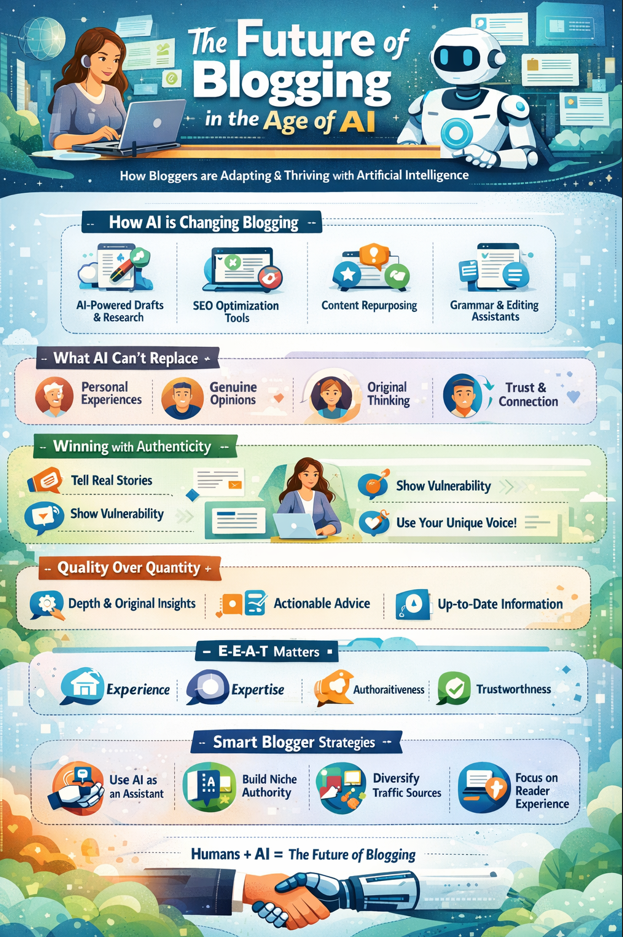
Artificial intelligence has already transformed how we use to create content, the future of blogging is different, what once took hours of researching, outlining, drafting, formating and publishing can now happen in minutes, tools powered by AI can generate blog posts, suggest headlines, optimize for SEO, and even create images and videos now
But this digital transformation in the age of AI goes beyond just speed, it’s changing what gets created and how much of it floods the internet every single day.
Here’s what AI can do well for bloggers:
- Research assistance — AI tools can summarize complex topics, pull data, and help you understand trends quickly.
- Content drafts — You can generate rough drafts and outlines in seconds, giving you a solid starting point.
- SEO optimization — AI-powered platforms analyze keywords, suggest meta descriptions, and help structure content for better rankings.
- Content repurposing — A single blog post can be turned into social media captions, email newsletters, and video scripts with the help of AI.
- Grammar and editing — AI tools like Grammarly and Hemingway polishes your writing instantly.
However, there’s a flip side also with AI-generated content often sounds generic, lacking personal stories, emotional depth, and original thinking. When thousands of bloggers use the same tools with similar prompts, the output starts to look and feel the same.
The real shift isn’t about whether AI can write. It’s about how bloggers use AI to enhance their unique voice rather than replace it.
The bloggers who understand this distinction are already ahead and they use AI for the heavy lifting task surch as research, structure, optimization — while also bringing their own experience and creativity to the table.
Key takeaway: AI is reshaping blogging from the ground up but it works best as an assistant, not the author.
What’s the future of Blogging will AI Replace it?
This is the question that keeps many creators up at night: is blogging dead with AI?
The short answer is no. Blogging is not dead but it is evolving.
AI can write a 2,000-word article in seconds, mimic different tones, follow instructions, and produce grammatically correct content, so why can’t it replace human bloggers?
Because readers don’t just want information, they want connection.
Here’s what AI still cannot do:
- Share personal experiences — AI hasn’t lived your life, it can’t tell your story of starting a business from your kitchen table or surviving a career change at 40.
- Offer genuine opinions — AI generates content based on patterns in data, it doesn’t actually believe anything. Readers can feel that difference.
- Build real relationships — Trust is built through consistency, vulnerability, and authenticity. These are deep human traits.
- Think originally — AI remixes existing information and doesn’t innovate or challenge ideas the way a human thinking can.
- Understand nuance and context — Cultural references, humor, sarcasm, and emotional sensitivity are areas where AI frequently stumbles.
Think of AI as a power tool. A power drill doesn’t replace the carpenter. It makes the carpenter faster and more efficient. The same applies to blogging and AI.
The bloggers who will thrive in future are those who treat AI as a collaborative partner, they let AI handle the repetitive, time-consuming tasks while they focus on what matters most — creating content that only they can create.
So no, AI won’t replace bloggers but bloggers who use AI will replace those who don’t.
How Authenticity Wins in the Age of AI
In a world flooded with AI-generated content, authenticity has become the ultimate competitive advantage.
Readers are getting smarter, they can sense when a blog post feels robotic, hollow, or recycled and they’re actively seeking out voices that feel real, honest, and human.
Here’s why authenticity matters more than ever in the age of artificial intelligence:
Readers Crave Real Stories
People don’t just read blogs for information, they read them for perspective, a blog post about “how to start freelancing” hits differently when it comes from someone who actually quit their 9-to-5 and built a freelance career from scratch.
AI can give you the steps. Only you can give the story behind those steps.
Trust is Built Through Vulnerability
When you share your failures, struggles, and lessons learned, readers connect with you on a deeper level but as for AI doesn’t have failures, It doesn’t struggle and that’s exactly why human-written content feels more trustworthy.
Your Voice is Your Brand
Every blogger has a unique way of expressing ideas in which your tone, your humor, your way of explaining things — that’s your brand, AI can mimic a tone, but it can’t be you.
Here’s how to keep your authenticity strong:
- Write from experience — Share what you’ve actually done, seen, or learned.
- Be honest about what you don’t know — Readers respect transparency.
- Inject your personality — Don’t be afraid to be funny, bold, or unconventional.
- Use AI for support, not substitution — Let AI help with research and structure, but write the core message yourself.
- Tell stories — Nothing connects humans like a good story. Use them generously.
The future of AI blogging isn’t about choosing between humans and machines. It’s about letting your humanity shine through in a sea of machine-generated noise.
Content Quality is Rising: Why AI-Generated Fluff Won’t Survive
There was a time when you could rank on Google with a mediocre 500-word post stuffed with keywords but those days have long been gone.
AI has made it incredibly easy to produce content at scale but as a result, the future of blogging drowning with low-quality, repetitive articles that say the same thing in slightly different ways and both readers and search engines are fighting back.
What’s Happening Right Now
- Readers bounce faster from generic content, if your post doesn’t offer something unique within the first few seconds, they leave.
- Google’s algorithms are getting smarter. They can identify thin, unhelpful content and push it down in rankings.
- Social media audiences share less when content feels templated or soulless.
What “Quality” Actually Means Now
Quality content in the AI era isn’t just about good grammar or proper formatting. It means:
- Depth over length — A focused 1,500-word post that goes deep on a topic beats a shallow 3,000-word article every time.
- Original insights — Share data, case studies, or perspectives that readers can’t find anywhere else.
- Actionable advice — Don’t just tell readers what to do. Show them how to do it with clear steps and examples.
- Updated information — AI tools are trained on older data. Bloggers who provide current, timely information have a clear edge.
- Visual and structural quality — Use headers, bullet points, images, and white space to make content easy to scan and digest.
The bar for content has been raised significantly. But here’s the good news: if you’re willing to put in the effort to create genuinely valuable content, you’ll stand out more than ever because so many others are taking shortcuts with AI.
Bottom line: AI-generated fluff is a race to the bottom. Quality, human-enhanced content is the path to long-term success.
Google, AI Content, and Why E-E-A-T Matters More Than Ever
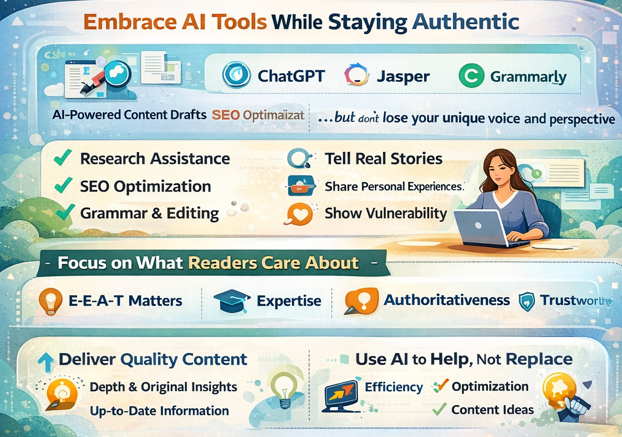
If you’re blogging for organic traffic, you need to understand how Google views AI-generated content and more importantly, you need to understand E-E-A-T (Experience, Expertise, Authoritativeness, and Trustworthiness).
Google’s Official Stance on AI Content
Google has made its position clear: they don’t penalize content simply because AI created it. What they care about is whether the content is helpful, reliable, and people-first.
In other words, it doesn’t matter how you create content at last what matters is the quality and value it provides to the readers.
However, Google has also been aggressive about targeting spammy, low-quality AI content that’s created purely to manipulate rankings. If your strategy is to mass-produce AI articles with no human oversight, you’re playing a dangerous game.
What is E-E-A-T?
E-E-A-T stands for Experience, Expertise, Authoritativeness, and Trustworthiness, it’s the framework Google uses to evaluate content quality, especially for topics that impact people’s lives (health, finance, legal, etc.).
Here’s what each element means for bloggers:
- Experience — Have you personally done or experienced what you’re writing about? First-hand experience is now a ranking signal. This is something AI simply cannot fake.
- Expertise — Do you have knowledge or skills in your topic area? Credentials, professional background, and demonstrated skill matter.
- Authoritativeness — Are you recognized as a credible source? Backlinks, mentions, and a strong online reputation build authority.
- Trustworthiness — Is your content accurate, honest, and transparent? Do you cite sources? Do you disclose affiliations?
Why E-E-A-T Matters More in the AI Era
Since AI can generate content on any topic — even topics it has no “experience” with — Google leans heavily on E-E-A-T to separate genuinely valuable content from the noise.
Here’s how to strengthen your E-E-A-T:
- Add author bios with real credentials and experience.
- Link to reputable sources to back up your claims.
- Share personal case studies and real-world results.
- Keep content updated and accurate.
- Build your reputation through guest posting, interviews, and social proof.
Blogging in the AI era without understanding E-E-A-T is like driving without a map. You might move forward, but you won’t reach your destination.
How SEO is Evolving in the Age of AI
SEO is not what it was even two years ago. The rise of AI has fundamentally changed how people search for information and how search engines deliver results.
If you want your blog to survive and grow, you need to adapt to these changes now.
AI Overviews and Zero-Click Searches
Google’s AI Overviews (formerly called SGE) now display AI-generated summaries directly at the top of search results. This means users often get their answers without clicking on any blog post.
Zero-click searches are increasing rapidly. For bloggers, this means:
- Informational queries are harder to rank for — If Google answers the question directly, fewer people visit your site.
- You need to target deeper, more complex topics that AI overviews can’t fully cover in a short summary.
- Featured snippets and structured data become even more important for visibility.
New Search Behaviors
Users are now searching in more conversational, long-tail ways thanks to AI assistants like ChatGPT, Siri, and Google’s own AI features.
Instead of typing “best blogging tips,” people now ask things like:
- “How do I start a successful blog in 2025 with AI tools?”
- “What’s the best way to keep my blog authentic when using AI?”
- “Is blogging still worth it in the age of artificial intelligence?”
This shift means bloggers should:
- Target long-tail keywords that match natural, conversational queries.
- Answer specific questions clearly and thoroughly within their content.
- Use FAQ sections to capture question-based searches.
What Still Works in SEO
Despite all the changes, some SEO fundamentals remain strong:
- High-quality backlinks still signal authority.
- Page speed and mobile optimization still matter for user experience.
- Internal linking helps search engines understand your content structure.
- Consistent publishing builds topical authority over time.
- Keyword research is still essential — but focus on intent, not just volume.
The new age of AI demands a smarter, more strategic approach to SEO. Bloggers who adapt their strategies will continue to attract organic traffic. Those who stick to outdated tactics will fall behind.
How Smart Bloggers Are Adapting with begening of AI Era
The bloggers who are winning right now aren’t fighting AI. They’re working with it — strategically and intentionally.
Here’s exactly how smart bloggers are adapting to the new era of blogging:
1. Using AI for Efficiency, Not Replacement
Successful bloggers use AI to:
- Generate content outlines and first drafts
- Research keywords and trending topics
- Edit and proofread faster
- Repurpose content across platforms
But they always add their own voice, insights, and experience before hitting publish.
2. Building Niche Authority
Instead of trying to cover everything, smart bloggers are going deep into specific niches. AI can produce surface-level content on any topic. But a blogger who specializes in one area — and shares genuine expertise — builds authority that AI cannot match.
3. Diversifying Traffic Sources
Relying only on Google is risky in the AI era. Smart bloggers are also building:
- Email lists — Direct access to readers without algorithm dependency.
- Social media communities — Engaged audiences on platforms like LinkedIn, Twitter/X, Instagram, and YouTube.
- Podcast and video content — Expanding reach beyond written blogs.
- Partnerships and collaborations — Guest posts, co-created content, and cross-promotions.
4. Focusing on Reader Experience
It’s not just about what you say — it’s about how readers experience your content. Smart bloggers invest in:
- Clean, fast-loading website design
- Easy-to-read formatting with clear headers and short paragraphs
- Visual elements like images, infographics, and videos
- Interactive elements like quizzes, calculators, or downloadable resources
5. Staying Updated
The AI landscape changes fast. What works today might not work six months from now. Successful bloggers stay ahead by:
- Following industry news and Google updates
- Experimenting with new AI tools regularly
- Analyzing their own data to see what’s working
- Being willing to pivot their strategy when needed
The key insight: Adaptation isn’t optional anymore. It’s the difference between bloggers who grow and bloggers who disappear.
Protecting Your Voice and Looking Ahead: The Future of Human-AI Blogging
As we look at the future of blogging, one thing is clear: AI is here to stay. It will only get more powerful, more accessible, and more integrated into every part of the content creation process.
But here’s the important part — so are human bloggers.
Protecting Your Authentic Voice
The biggest risk in the AI era isn’t that machines which will take over. It’s that bloggers will voluntarily give up their voice by letting AI do all the thinking and writing.
To protect your authenticity:
- Set boundaries with AI — Decide which parts of your process AI handles and which parts remain fully yours.
- Read your content out loud before publishing, does it sound like you? If not, rewrite it.
- Share opinions that AI can’t generate — Take stands, challenge popular ideas, and offer fresh perspectives.
- Connect with your audience personally — Reply to comments, engage on social media, and build real relationships.
- Remember why you started blogging — Whether it was passion, purpose, or profession, let that motivation guide your content.
What dose Future Holds for Blogging
The future of blogging in the age of AI is not about humans versus machines. It’s about humans with machines.
Here’s what we can expect going forward:
- AI tools will become standard — Just like WordPress and SEO tools became standard, AI writing assistants will be a normal part of every blogger’s toolkit.
- Content standards will keep rising — As AI makes content creation easier, readers and search engines will demand even higher quality.
- Personal branding will matter more — People will follow bloggers they trust, not just topics they search for.
- New content formats will emerge — AI will enable interactive, personalized, and multimedia content experiences that we can’t fully imagine yet.
- Community will become the real currency — Bloggers who build loyal, engaged communities will be far more resilient than those who depend solely on search traffic.
Final thoughts
The future of blogging is not dying but rather than its transforming and the bloggers who will lead this transformation are the ones who embrace AI as a powerful tool while never losing sight of what makes their content truly valuable — their unique human perspective.
The age of artificial intelligence doesn’t mean the end of blogging. It means the beginning of a smarter, more authentic, and more exciting era for creators who are ready to evolve.
What maters is your voice, your experience and your story, No algorithm or AI model can change that.
Now go write something only you can write. 🚀
Here is a article that can help you “Start Writing Blogs” https://insightpress.xyz/how-to-start-writing-blogs/
Common question people also ask:
Is blogging dead with AI?
No, Blogging is not dead. The future of blogging is chnaging with AI on how content is created, but human bloggers who offer authentic experiences, original insights, and genuine expertise are more valuable than ever. AI is a tool that enhances blogging, not a replacement for it.
What is E-E-A-T and why does it matter for bloggers?
E-E-A-T stands for Experience, Expertise, Authoritativeness, and Trustworthiness. Google uses this framework to evaluate content quality. In the age of AI, demonstrating real experience and expertise helps your content rank higher and build reader trust.
How is SEO changing because of AI?
AI overviews and zero-click searches are reducing traffic from simple informational queries. Bloggers need to target deeper topics, use long-tail keywords, and diversify traffic sources beyond just Google search.
Is Blogging Worth It in 2026?
Yes, blogging is still worth it in 2026 — but only if you do it right. Gone are the days of publishing thin, keyword-stuffed posts and expecting results. Today, successful blogging requires quality content, genuine expertise, and a smart content strategy. Bloggers who focus on solving real problems, building community, and leveraging AI as a tool are seeing strong results, whether you blog for passive income, personal branding, or business growth, the opportunity is still massive in 2026.
What is the future scope of blogging websites?
The future scope of blogging websites is expanding rapidly. AI-powered tools are making content creation faster and smarter. Niche blogs are attracting loyal, high-value audiences with that blogs are also evolving beyond just text into video, audio, and interactive experiences with e-commerce integration, voice search optimization, and growing global internet access, blogging websites are becoming full-scale digital businesses with massive growth potential.