Let’s be honest for a second.
You spent hours writing that blog post. You work extremely over what the headline should be, triple-check the grammar, add the perfect featured image — and then you hit publish.
And then… Nothing, Nothing Happens.
No traffic, No comments, No shares, Just the Silence.
It’s not that your content is bad or not useful, sometimes it’s the other thing that most of the bloggers miss. Promotion, publishing is only the beginning, after publishing you cannot sit, thinking by blog is good and google we surrey show it to the reader, that’s what most of the bloggers do but have you ever noticed well known bloggers like Neil Patel, Gary Vaynerchuk, Darren Rowse, etc also uses many platforms as well as paid advertisement to promote their blog, WHY, because to attract the readers from everywhere possible.
Here’s the good news? You don’t even need a single dollar to do it.
Whether you’re a brand-new blogger, intermediate or an experienced blogger and trying to sharpen your free promotion strategy, this guide covers everything. You’ll learn how to promote your blog for free using platforms you already know, tactics you haven’t considered yet, and strategies that successful bloggers use every single day.
Let’s get into it.
The Mindset Shift That Changes Everything
Before we jump into platforms and tactics, here’s the most important thing to know:
Blogging is 30% content creation and 70% promotion.
Read that again. Most new bloggers flip this ratio — they spend all their energy writing posts and almost no time getting those posts in front of people. The bloggers who grow fast think about promotion before they even start writing. They ask: “Where will I share this? Who is this for? What platform will amplify this? Where can my targeted audience be”
Once you adopt that mindset, everything else clicks into place.
Start Where You Already Are: Your Own Blog
The best free promotional platform you own is your own website — and most bloggers completely ignore it.
Every new post you publish is an opportunity to send existing readers deeper into your content, use a related posts plugin or widget at the bottom of every article & more importantly, go back to your older posts and manually link to your new content within the body text which is called internal linking, and it’s one of the most underrated free strategies for both keeping readers on your site longer and boosting your SEO rankings on Google.
Another powerful tactic: Create round-up posts, Compile your five best articles on a topic into one mega-resource. That single round-up then promotes all five of those posts every time someone visits it. You’re essentially getting five posts worth of promotion for the effort of writing one.
This is your foundation. Build it strong before you go anywhere else.
Pinterest: The Free Traffic Machine Most Bloggers Underestimate
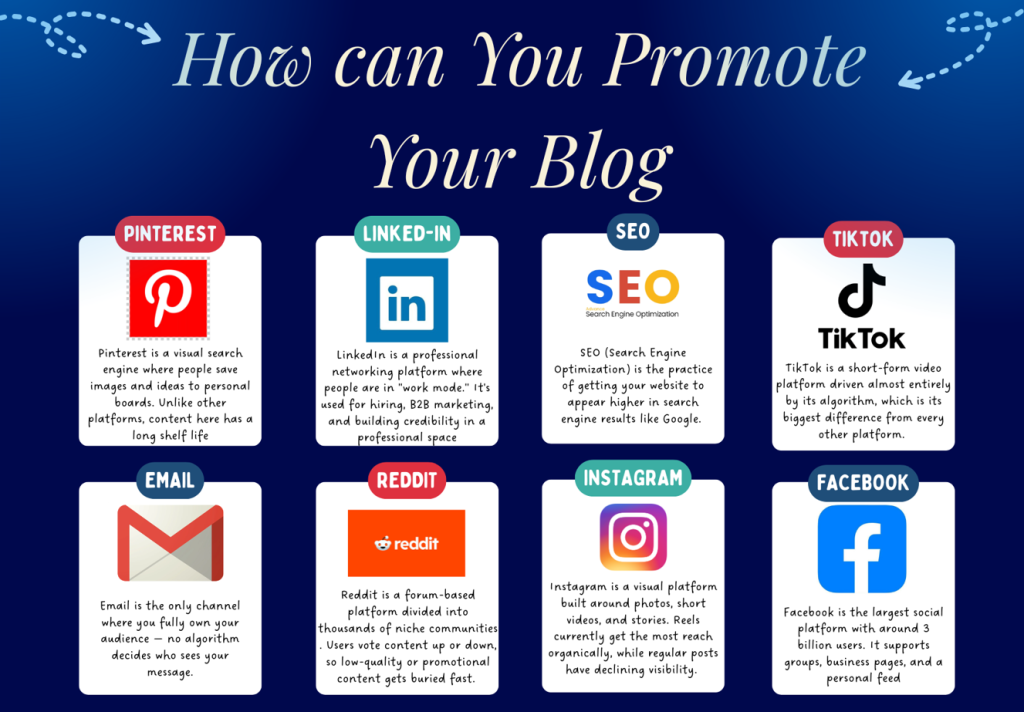
If you’re not using Pinterest to promote your blog, you’re leaving a massive source of free traffic on the table — and this is especially true for bloggers in lifestyle, food, travel, personal finance, DIY, education, and health niches.
Here’s why Pinterest is different from other social platforms: it’s a visual search engine, not a social media feed. Pins don’t disappear after 24 hours like Instagram Stories or tweets. A pin you create today can still drive traffic to your blog three years from now. That’s the kind of compounding return that makes Pinterest one of the best free platforms to promote your blog.
How to get started the right way:
Set up a free Pinterest Business account which gives you the access to analytics and the ability to create Rich Pins, which pull metadata from your blog automatically. Then, design eye-catching vertical graphics for each blog post (Canva is free and excellent for this). Your pin image needs a bold, readable headline and visuals that stop someone mid-scroll.
Pin consistently — at least once a day is the sweet spot in 2026. Use keyword-rich descriptions in your pin captions because Pinterest’s algorithm uses those words to decide who to show your pins to. Think of it like SEO, but for images.
Real-world example: Jeff and Ben at DollarSprout used Pinterest as their primary growth engine in the early days, achieving a staggering 115,000%+ growth in Pinterest traffic over three months. They didn’t use paid ads. They created great pins consistently, understood their audience’s visual preferences, and showed up every day.
Facebook: Groups Are Your Secret Weapon
Your blog’s Facebook Page is a good start, but the real free traffic magic on Facebook happens inside Groups — both your own and others’.
There are two ways to play this:
Strategy 1: Join niche-specific Facebook Groups. Search for groups related to your blog topic. A parenting blogger, for example, can find dozens of active parenting communities where readers would genuinely benefit from their content. Most groups have weekly promotional threads — “Share Your Latest Post Mondays” and similar — where you can drop your link. The golden rule here: reciprocate. Engage with other people’s posts before and after you share your own. Bloggers who drop a link and vanish get ignored (or removed).
Strategy 2: Join blogger-specific Facebook Groups. There are thousands of Facebook groups designed specifically for bloggers to share each other’s content. These work on a mutual-support model where you share another person’s post and they share yours, multiplying your reach exponentially without spending anything.
A few pro tips for Facebook promotion that actually work:
Don’t always promote the same post, rotate between new content and your best older posts to revive their traffic.
When you share a post, write a compelling intro sentence rather than just pasting a link. A question or a surprising stat gets far more clicks.
Limit yourself to 4–5 groups per day so you can genuinely reciprocate within the required time window.
Want to go even further? Create your own Facebook Group centered on your niche. Over time, this becomes your most loyal audience — people who opted in specifically to hear from you. You control the content, the promotion timing, and the community culture. It takes time to build, but it becomes one of your most powerful free promotion assets.
LinkedIn and LinkedIn Puls: The Underused Gold Mine
If your blog touches anything related to business, careers, finance, marketing, education, or professional development, LinkedIn is one of the best free platforms for blog promotion that most bloggers dramatically underuse.
Here’s the key: don’t just paste a link to your blog post and call it a day. Instead, republish adapted versions of your content directly on LinkedIn Pulse (LinkedIn’s native publishing platform). Write a condensed version of your post — maybe 500–700 words — and at the end, add a clear call to action: “Want the full breakdown? Read the complete guide on my blog.”
LinkedIn’s algorithm actively promotes articles published natively on the platform. It recommends them to professionals who follow relevant topics, which means your content can reach people completely outside your current network — all for free.
Optimize your LinkedIn profile with keywords related to your niche. Make sure your blog URL is visible in your profile. Join LinkedIn Groups in your industry and participate in discussions, subtly establishing yourself as a go-to voice before you share your own links.
Increase blog engagement on LinkedIn by ending every post with a question. “What’s your biggest struggle with [topic]?” invites comments, and comments push your post higher in the feed. This is one of the most effective community engagement tactics for promoting a new blog.
SEO: The Free Traffic Strategy That Keeps Paying You Back
Every other strategy in this guide drives traffic today. SEO drives traffic every single day, indefinitely — and it’s completely free if you do it yourself, a SEO optimized content is far more superior to a normal content.
Effective SEO strategies for blog visibility without spending money:
Start with keyword research. Use free tools like Google Search Console, Google’s autocomplete feature, and AnswerThePublic (free tier) to discover the exact phrases people are searching for in your niche. You’re looking for keywords with decent search volume but manageable competition — these are your golden opportunities.
Write for humans first, search engines second. Google’s 2023–2026 algorithm updates have been ruthless toward thin, keyword-stuffed content. What ranks today is content that genuinely helps people: comprehensive, well-structured, original, and written by someone who actually knows their topic.
Master on-page SEO. Every post should have your target keyword in the title, the first paragraph, at least one H2 subheading, and naturally throughout the body. Add alt text to every image. Write a compelling meta description that makes someone want to click, These cost nothing and make a measurable difference.
Internal linking is your secret SEO weapon. Every time you publish a new post, go back to 3–5 older relevant posts and add a link to the new one. This spreads “link equity” across your site and tells Google which pages are important. Most bloggers skip this step entirely — which is why doing it gives you a real competitive edge.
Get free backlinks through guest posting. When another website links to yours, Google treats it as a vote of confidence. Guest posting — writing articles for other blogs in your niche — earns you those backlinks for free while also exposing you to entirely new audiences.
Real-world example: Many bloggers who commit to a keyword-focused SEO strategy for 6–12 months report seeing their traffic double, triple, or more — without any ad spend. SEO is slow to start, but it’s the only promotional strategy that generates truly passive traffic.
Build Your Email List: The Asset That Belongs to You
Here’s a frightening thought: Instagram could change its algorithm tomorrow and cut your reach by 80%. Facebook could limit your page’s visibility overnight. Google could update its rankings and drop your site. These things have all happened to real bloggers.
Your email list? No one can take that from you. It’s the one audience asset you fully own.
How to build an email list for your blog without paid advertising:
Start with a compelling lead magnet — a free resource so valuable that readers hand over their email address to get it. This could be a checklist, a PDF guide, a mini email course, a template, or a cheat sheet. Make it ultra-specific to your niche.
“10 Free Canva Templates for Food Bloggers” will outperform “Sign up for my newsletter” every single time.
Use a free email marketing tool like Mailerlite (free up to 1,000 subscribers) or the free tier of ConvertKit to set up your opt-in form. Place it in at least three locations: your website header, within blog post content, and as an exit-intent popup.
Once people are on your list, send them genuine value every week. A roundup of your latest posts, behind-the-scenes insights, exclusive tips — whatever feels natural for your voice. The bloggers who grow the fastest treat their email subscribers like their most important readers, because they are.
Also: always include your two or three best blog posts in your welcome email sequence. New subscribers are at their most engaged right after they sign up — that’s the perfect moment to pull them deeper into your content.
Medium, Quora, and Reddit: Distribution Platforms That Do the Lifting
These three platforms let you get your content in front of audiences who are already searching for exactly what you write about.
Medium hosts nearly 100 million monthly visitors. Publish adapted versions of your posts there with a link back to the full article on your blog. Use Medium’s tagging system carefully — the right tags place your content directly in front of readers following those topics.
Quora is a question-and-answer platform with over 400 million monthly users. Search for questions in your niche, write genuinely helpful answers (not thinly-veiled ads for your blog), and naturally include a link to a relevant post when it adds real value. Build a reputation as a helpful expert first; the traffic follows.
Reddit requires the most patience. Communities (subreddits) are notoriously suspicious of self-promotion. The way to use Reddit effectively is to become a genuine, valuable contributor first — answer questions, join discussions, add value over weeks and months. Once you’ve built credibility, sharing a relevant link from your blog feels natural rather than spammy.
TikTok & Instagram: For When You're Ready to Go Vertical
Short-form video is the fastest-growing organic content format right now. TikTok’s algorithm is remarkable in its ability to show your content to new people, even if you have zero followers. Instagram Reels works similarly.
The strategy isn’t complicated: take the key insight from a blog post, explain it in 30–60 seconds on camera, and direct viewers to your bio link for the full article. Use trending sounds, hook viewers in the first two seconds, and caption every video for accessibility.
This is genuinely one of the most effective ways to increase blog traffic organically using social platforms right now — and it costs nothing but your time.
Real Success Stories: What Free Promotion Actually Looks Like
Case Study 1 — Margaret Bourne (MargaretBourne.com): A blogging coach who used Pinterest as her cornerstone promotion channel, pinning consistently once a day and using Tailwind for automation. The result was a dramatic and sustained jump in outbound clicks — especially impressive because blogging-tip niches are far less visual-friendly than lifestyle niches.
Case Study 2 — DollarSprout (Ben Huber & Jeff Proctor): Built their personal finance blog primarily through Pinterest, eventually achieving over 115,000% growth in Pinterest traffic over a three-month period. No paid ads. Just consistent, audience-focused pinning combined with high-quality content.
Case Study 3 — Seaside Sundays (Gemma): Went from 0 to 90,000 pageviews in just 9 months using a combination of Pinterest group boards, Facebook promo groups, and Tailwind Communities — all free strategies consistently executed.
The common thread? They chose 2–3 channels, committed to them for months, and didn’t quit when growth was slow.
What About Paid Promotion? (The Honest Answer)
Free strategies work — but they take time. If you’re ever ready to accelerate, the most cost-effective paid upgrades include: Pinterest promoted pins (highly targeted and affordable), Facebook Ads for boosting your best-performing posts, and tools like Tailwind’s paid plans for scheduling automation.
Think of paid promotion as a volume knob, not a replacement for the free strategies above. It amplifies what’s already working. If your free Pinterest strategy is driving traffic, a small promoted pin budget can scale that significantly. But if your content isn’t connecting organically yet, paid promotion won’t fix it — it’ll just drain your budget faster.
Your Free Blog Promotion Action Plan
Here’s how to put this all together without burning yourself out:
When you publish a new post: share it to your email list, pin it on Pinterest, post it to your Facebook Page and relevant groups, share it on LinkedIn, and drop it into your most active blogger Facebook communities.
Each week: publish one Quora answer in your niche, update one old post with internal links to new content, and engage meaningfully in 2–3 Facebook groups.
Each month: repurpose one post into a Medium article, pitch one guest post opportunity, and review your Google Search Console data to find which keywords are already bringing you traffic (then write more content on those topics).
That’s it. Simple, sustainable, and completely free.
Now It's Your Turn
You’ve just read everything you need to start promoting your blog for free and growing real, engaged traffic — today.
But information without action is just useless.
Pick one strategy from this guide (Just one) Commit to it for 30 days before adding another, whether that’s creating your first Pinterest board, writing your first Quora answer, or finally setting up that email opt-in you’ve been putting off — do it today and if this guide helped you, do one more thing: share this post with a blogger friend who needs it. The blogging community grows when we lift each other up — and sharing great content costs nothing.